
Misfits at War
A review of The Foreigner Group

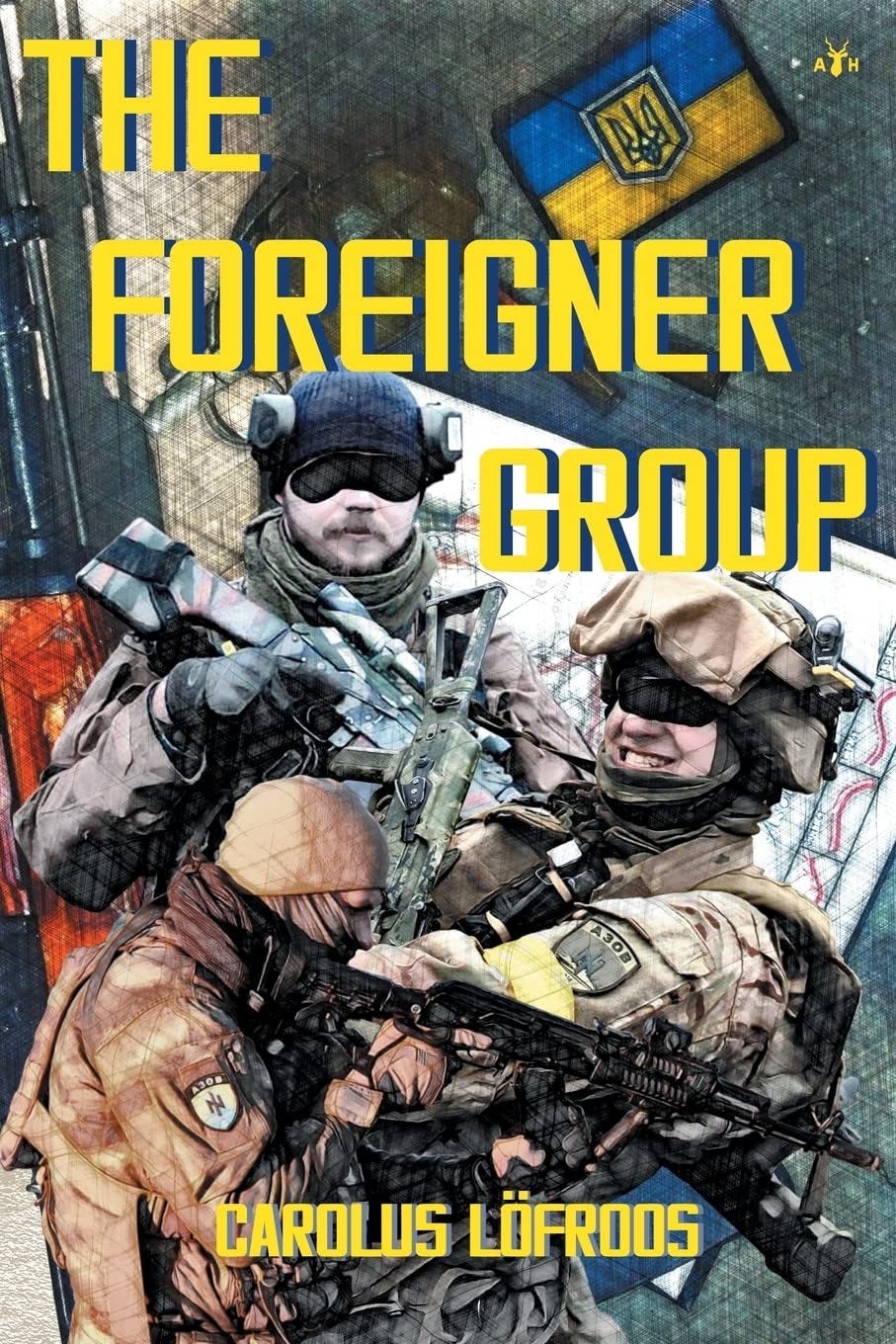
Ziggers are an eternal blight on the online right. Brain dead Duginist types at worst or misguided Russian Orthodox converts at best. That slur of course doesn’t exist in The Foreigner Group because this war memoir covers only 2014 - 2015 of the nascent conflict in Ukraine. Published by Antelope Hill The Foreigner Group is the account of Carolus Löfroos a Swedish volunteer who fought with the Azov group. It’s an entertaining read that I devoured over a few short days and I think represents one of the better written accounts of the chaotic early years of the conflict.
Perhaps what stands out most to me in the book is the general level of incompetence that happens in these conflicts. Keep in mind that this is 2014 and that there have been huge levels of improvement from many of the Ukrainian organizations mentioned. In fact some of the combat footage from Azov guys today online is very insightful and competent stuff. Great small unit tactics and patrolling in hostile territory, but that is now and this was then. Azov and the Ukrainians in the book are learning, as are the other international volunteers that Carolus finds himself surrounded with. The other obvious incompetents mentioned are of course the Russians but more on that later.
I went into this book expecting a bit more of a fast paced account and it most certainly is not that. This is however one of the most insightful and honest accounts of men who don’t fit in and are seeking something else. The conflict itself was much more muddled and complicated than the clear cut invasion and war that continues to rage. Carolus details to us his entire journey to combat and it certainly takes a while, we journey through the haphazard recruiting process and waiting around in Kyiv, he takes us to the training camp where he and a bunch of other international misfits slowly coalesce together into a semi-competent fighting force before he leaves for a while because things are basically so pointless and dull before he heads back and gets a real taste of combat and war. If you’re looking for a bad ass kill lots of enemies style memoir look elsewhere (Three Sips of Gin might be right up your alley).
It’s the people that make this account so compelling. A cast of characters that we all know and have met ourself in life, from the compulsive charlatan of ‘Mike’ to the verbose intellectual racist known as ‘The Greek’ they are all present. Men who were drawn to go to war with Azov in 2014 weren’t like the more mainstream volunteers who appeared in 2022. They were much more dysfunctional. Former hooligans and petty criminals, war junkies and humanitarian types, born soldiers and wanderers. The Greek stands out as perhaps the most memorable of the lot followed by another Swede Langstrom. Both come across as men out of time without Carolus having to explicitly tell us that. Men thrilled by combat and cheating death, ticking off experiences and forever restless. For most of us that is beaten out of us whether generationally or just sensibly but these men aren’t like that. They were there on the front lines in a conflict few cared about and many paid a great personal cost for their involvement.
What struck me a lot as well was just how poorly equipped and under prepared everyone seemed to be. We are spoiled here in America with the access we have to guns and ammunition but also just soft gear. The struggle Carolus goes through trying to get a gun that actually works is quite insane for any firearm nerd to read about. The overall training they basically do themselves and from the background of the cast they mostly have solid experience but not all. French Foreign Legion, Swedish and Finnish conscripts, Italian army and others end up thrown together under their own direction. These men want to fight and do cool shit, indeed half of the time it appears their major struggle is just getting missions that actually seem worthwhile in the weird chaos of the conflict at that time. When we do finally get into the combat writing it doesn’t disappoint and Carolus is again a seemingly honest writer. He doesn’t gloss his own flaws and mistakes, far from it, if anything I was surprised by how candid he was about his own fitness failings.
For him it was about being alive, feeling alive. I’ve never been to war so I don’t know what that is like. I have been down range of friendly gun fire. I have pushed myself to my limits on my motorcycle, I have fought hand to hand, I’ve ambushed and patrolled as training but I’ve never been to war. I can only imagine what it’s really like but I understand the urge to want to live on the edge and taste life like that. It’s the same for the other men in the book. They want to live. The Greek is the most overtly political and philosophical character and conveys the most in the narrative. He’s also the funniest which helps. Carolus doesn’t try to dress anything up like Evola would nor does he see himself as some kind of Junger figure either. He just wants to test himself and go to war.
Considering the political background and nature of the war there is remarkably little commentary on that front. Carolus is almost a bit too eager to hand wave it all away, which I think is probably genuine but also struck me as a little odd. Perhaps it is a function of the time or the language barrier or just he didn’t feel it was as relevant. It’s surreal of course to read about some of the places they were that are now totally destroyed and to think of all these nationalists who lie dead in the soil of their homeland. The Russians are the obvious enemy and Carolus captures that innate kind of dislike so many have for them. The Russians are also painted as a rather incompetent foe who are easily scared and still unprofessional. That much is certainly true as we have seen. The low level of skill and training is just quite apparent in some of the battles and engagements fought. At this stage of the war though they still have total artillery domination. Drones also feature as a foreboding shadow of what was to come, in this instance largely just as recon.
This memoir was a good one. It struck me as honest. It was chaotic in the right way that reflected the reality of the conflict. It had all the lulls and false climaxes one expects in waiting to go to war. It had just the kind of people one would expect to be willing to travel to Ukraine in 2014 looking for a war. More of those types exist and their stories are often never told. They are gate kept lest other men fall into the life of the war band. An ever fluid koryos that has nor fixed goal or purpose. Perhaps the saddest part of the book though was Carolus’s treatment on his return. His being shunned by men he thought were his friends because he was tainted having gone and fought for the “Nazis” that really was a sobering reflecting on Swedish masculinity. The epilogue left me wanting to know more, had the charismatic Greek really gone to his death unarmed? What did Carolus himself do in 2017 when he mentions returning to fight again? Has he gone back now or is it finished for him? Who of the Frenchmen are still alive and kicking? The ending leaves almost more questions than answers but as a living piece of history of battle brothers The Foreigner Group is a worthy read.